.jpg)
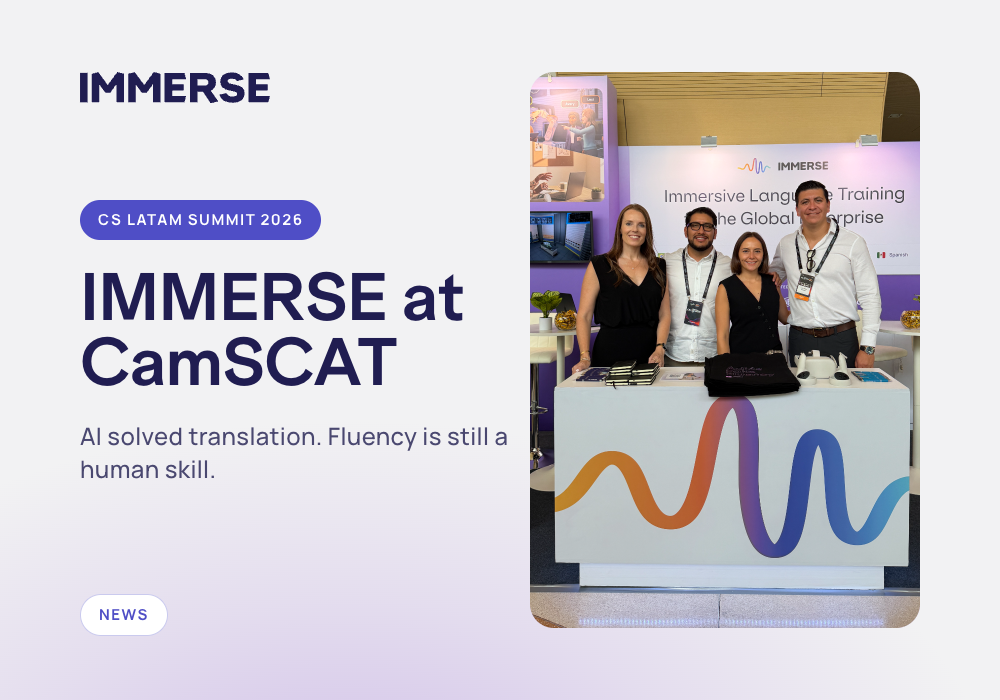

Kristin Smith's keynote at the CS LATAM Summit argued that AI has solved translation and left fluency untouched, and that Costa Rica is unusually well placed because of it
“¡Buenos días a todos! I’m so excited to be here — la verdad…” At CamSCAT’s CS LATAM Summit 2026, IMMERSE SVP of Sales Kristin Smith opened her keynote mixing English and Spanish. Afterward, she asked the audience if they had noticed.
She wasn’t translating between languages. She was simply communicating, choosing whatever words felt natural in the moment. Linguists call this code-switching.
Bilingual speakers code-switch often, and it’s a sophisticated skill. In addition to knowing two languages, it requires understanding the people you’re talking to and meeting them where they’re at. As AI translation becomes more common, this raises an important question:
What happens when communicating well requires more than translation?
Translation is not fluency
In her keynote, Smith made a simple argument: AI has closed the translation gap, but it has not closed the fluency gap. The better machine translation gets, the easier it is to see what it doesn’t provide.
AI can increasingly solve the problem of not knowing the words. But having the words is not the same as understanding the context they’re being used in. Fluency is the more sophisticated skill of operating directly in a language: choosing how to use words in a way that fits the person and the interaction.
In global business, that skill is cultural as well as linguistic. We don’t just change languages. We change how we communicate.
What the Culture Map explains that a translator can't
To explain how communication styles vary from one country to another, Smith turned to Erin Meyer’s The Culture Map. Meyer uses seven scales to compare international differences in business culture, including how people communicate, make decisions, and express disagreement. In her keynote, Smith focused on the book’s concept of low-context versus high-context communication.
In low-context cultures like the United States, meaning is usually stated directly. The words themselves are expected to carry most of the message. In high-context cultures such as Japan, tone of voice and pauses often carry additional meaning, and what is left unsaid can be important.
A listener who relies solely on translation can miss the actual meaning. In Japanese business meetings, “that would be difficult” often means “no.” A literal translation could leave the listener pursuing a negotiation that the speaker considers closed. As Smith told the audience, that’s the danger of thinking that translating is the same as understanding.
Costa Rica's double fluency
The only Latin American countries included in The Culture Map’s original data are the region’s three largest economies: Mexico, Brazil, and Argentina. Costa Rica isn’t in that data, as Smith told the audience at the CS LATAM Summit. She used Meyer’s framework to extrapolate her own argument that culturally, Costa Rica is bilingual in ways that go beyond language.
With regional Latin American colleagues, Costa Rican teams operate in a more relational, higher-context style, where trust is built through relationships and more meaning is left implicit. At the same time, decades of U.S. investment and shared-services work have trained the same workforce to communicate in a more direct, task-oriented way with headquarters. Costa Rican teams move between these styles every day, often without thinking about it.
This ability to culturally code-switch is a business asset. It can reduce friction with headquarters, speed decisions, and help teams build trust with colleagues and clients in other Latin American countries like Argentina, Colombia, Brazil, and Mexico. Costa Rican teams can also switch styles when communicating with headquarters in low-context countries. While limited rates of foreign-language proficiency in Colombia may be constraining shared-services growth there, Costa Rica’s existing cultural fluency gives it an edge.
That cultural fluency strengthens the case for expanding operations in Costa Rica based on workforce capability, not cost alone. Costa Rican teams can work effectively across different languages, cultures, and expectations.
Where AI helps, and where it stops
Smith’s keynote did not argue against AI. She praised AI as a language tool that can translate, correct grammar, and give people more confidence writing emails. Yet it cannot read a face or recognize when silence means no.
Linguist Merrill Swain uses the term “languaging” for the way we use language not just to communicate but to make meaning, shape experience, and belong to a community. When Smith first moved to Mexico City, she was fluent in Spanish but not in Mexican culture. She was baffled when people called their own homes tu casa, “your house.” Later, she figured out the phrase was their way of expressing warmth and hospitality.
That was when she understood the difference between translating a language and being fluent in a culture.
Three things to do next quarter
Smith closed her keynote at CS LATAM Summit 2026 with three recommendations for those leading talent in Shared Services, GBS, and BPO environments:
Diagnose where fluency gaps are costing the business. Look for stalled decisions, avoidable misunderstandings, or capable employees who hesitate to present in English. The Fluency Gap Calculator can help estimate the financial impact of those gaps.
Build human practice alongside AI. Use AI where it helps, but employees still need opportunities to develop fluency in live interactions. They need authentic, low-stakes practice that requires them to read the room, adapt their communication style, and handle difficult conversations without damaging relationships.
Make the case upward in terms of cultural fluency, not just cost. In Costa Rica, the ability to switch between regional and headquarters-facing communication is already a workforce capability. When making the case for expansion, put that capability alongside the usual cost considerations.
Fluency is more than accurate translation
CEFR, a widely used framework for assessing language proficiency, includes cultural context as part of what learners need to communicate fluently. AI provides sophisticated sentence translation, but without the sociocultural understanding that human fluency entails.
The gap between accurate word translation and full understanding is where Costa Rica’s talent shines. Their ability to move between languages, cultures, and ways of working is more than just a language skill. It's a competitive advantage.
Follow IMMERSE on LinkedIn for more conversations about workplace fluency.
FAQ
Is AI going to replace language learning?
Not in every situation. AI can be useful for translating webpages or facilitating straightforward exchanges, but it lacks the nuanced situational awareness and cultural understanding that a multilingual human speaker brings to an interaction. And even an excellent face-to-face translation can create a slight separation between the people communicating because the words are not fully in sync with their tone and facial expressions. When communicating well requires more than translation, human fluency still matters.
What’s the difference between translating and being fluent in a language?
Translating is converting the words of a message from one language into another. Fluency is operating directly in the language itself: choosing what to say in real time based on the person and situation. A fluent speaker can communicate naturally without translating every thought first. They also understand the cultural expectations that shape the way people communicate with one another.
What do high-context and low-context communication mean?
“High-context” and “low-context” are terms describing how much meaning is communicated through words versus context. In low-context cultures like the U.S., people typically say what they mean directly. In high-context cultures like Japan, shared context, tone of voice, and silence convey more meaning. Latin America typically falls in the middle, though norms vary by country. Context levels matter in international business. For instance, “that would be difficult” can signal “no” in some cultures but invite problem-solving in others.
Why is Costa Rica’s workforce described as culturally bilingual?
IMMERSE SVP of Sales Kristin Smith has used Erin Meyer’s Culture Map framework to describe Costa Rican teams as culturally bilingual, using a more relational, higher-context communication style with regional colleagues and switching to a more direct, task-oriented style with headquarters. While Meyer’s data on Latin America came from Mexico, Brazil, and Argentina, Smith applied the framework to Costa Rica to argue their cultural fluency is a business asset headquarters should consider when deciding whether to expand existing operations there.
How do I know whether language fluency is actually costing my organization anything?
Look for business problems that may have communication gaps at the root. Decisions slowed by the need for translation and escalations that turn out to be cultural or language-based misunderstandings can both cost your organization money. So can strong employees who struggle to communicate with customers, hesitate to give presentations, or hold back in meetings because they lack speaking confidence. These can all be signs that limited fluency is affecting your bottom line.
Can AI conversation practice replace practice with a human?
Not entirely. AI can be useful for practicing vocabulary and grammar. It can also help learners build speaking confidence by acting as a patient, nonjudgmental conversation partner. However, learners still need human practice, where the social stakes are real. Learners know the other person is forming an impression of them. They must read that person’s reactions and adjust in real time. That practice helps them keep communicating effectively even in difficult conversations and high-pressure situations.