.jpg)
.jpg)
The Bilingual Ceiling: Why Colombia's SSC Boom Hits a Wall at 40%

Cartagena, Colombia. At GBS Day at the CX Summit, the official story was on full display. Colombia's Shared Services industry, unstoppable. 90+ centers. Multinationals expanding every quarter. A workforce ready to compete globally.
Walk the hallways between sessions and a quieter story surfaces. The leaders in the room have been carrying it for a while.
The Number No One Wants to Say Out Loud
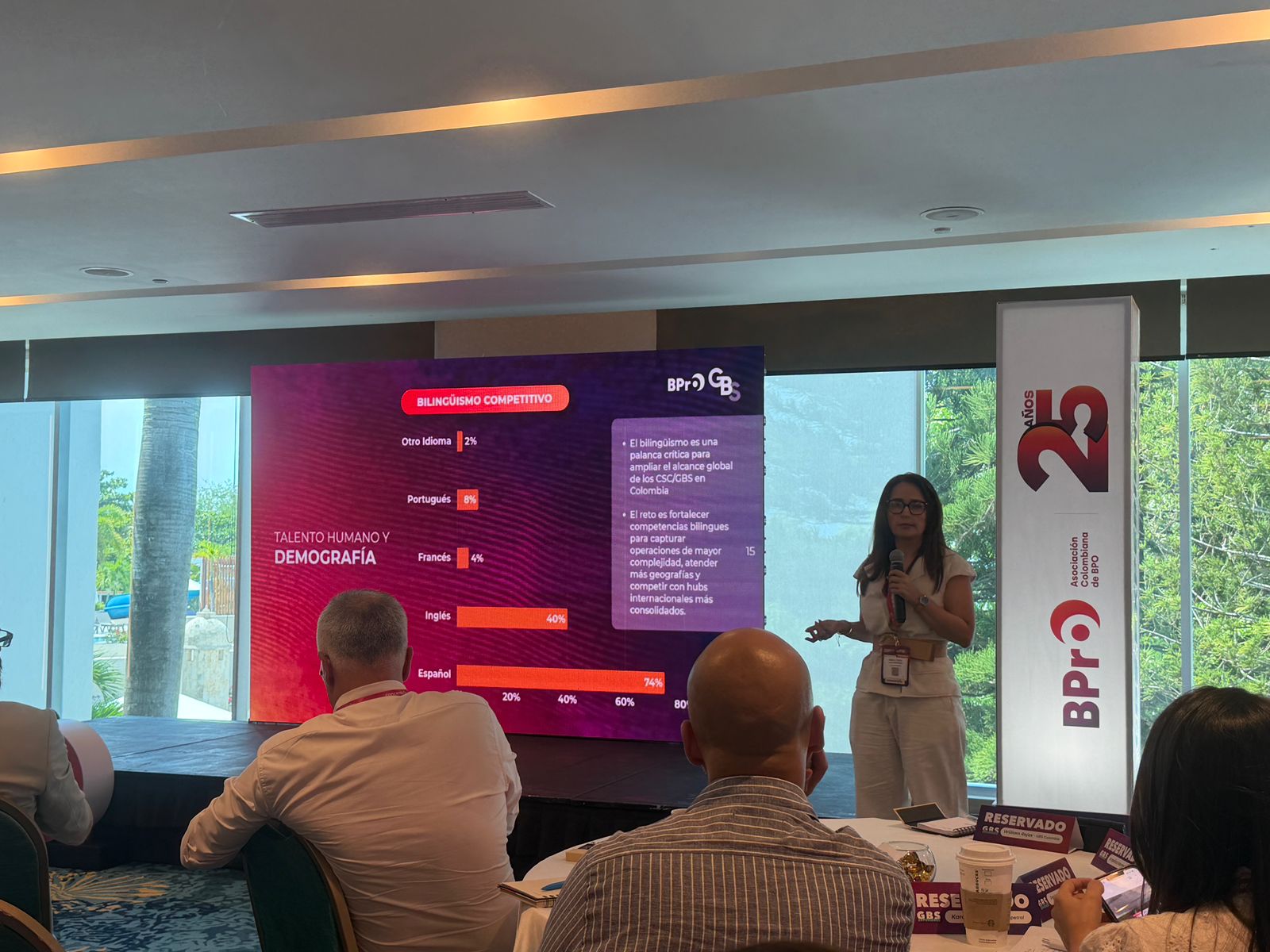
Less than 40% of employees at Shared Services Centers across Colombia are fluent in English.
Read that as a meaningless HR statistic and you miss the point.
This is a hard ceiling on the country's economic ascent — quietly capping how fast SSCs can scale and how much of the LATAM nearshoring opportunity Colombia actually captures.
Kristin Smith, SVP of Sales at IMMERSE, put it plainly:
The operational playbook for world-class SSCs already exists. Bernardo Londoño's session on DHL's center walked the room through it — a masterclass in how to build one. What no playbook on stage can fix is the talent pipeline underneath.
Why Traditional Training Can't Close the Gap
Every SSC leader in that room has already tried to fix this. Course platforms. Certifications. Generic chatbots bolted onto LMS dashboards. And every leader has lived with the same result: certified employees who still go silent on the call.
This is Fake Fluency — proficient on paper, paralyzed in practice. It's the reason the 40% number hasn't moved despite years of investment.
The cost is silent, but detrimental to company productivity, employee satisfaction, and business performance.
Organizations lose an estimated 4 hours per employee per week to fluency gaps. For a 1,000-seat SSC, that's ~$4.7 million leaking out the bottom every year — before you count the escalations that get misread, the deals that never close, and the talent passed over for promotion because they can't lead the client call.
From Language Training to Fluency Performance
More training won't move the number. The problem sits one layer up, in the category itself.
This is what Fluency Performance means. You stop measuring course completion and start measuring whether someone can lead a customer call without a translator. You build immersive AI practice environments with role-specific scenarios — the actual conversations an SSC analyst, agent, or team lead navigates every day. You replace LMS dashboards with business outcomes.
The numbers speak for themselves: 88%+ engagement (versus 10–20% in traditional programs), measurable workplace fluency in weeks, and a direct line from communication capability to SSC throughput, CSAT, and retention.
Colombia doesn't need more language training. It needs Fluency Performance.
The Question the Room Was Really Debating
Listen closely to the conversations in Cartagena and the vendor questions fade. What the leaders were really circling was national in scope: which countries own the next decade of global services delivery, and which watch the work route around them.
The future of shared services in Latin America is being written right now. The question is: are we preparing talent to star in it?
Thanks to Ana Karina Quessep and the team for putting Colombia at the center of the global GBS conversation. IMMERSE was honored to be in that room.
.jpeg)