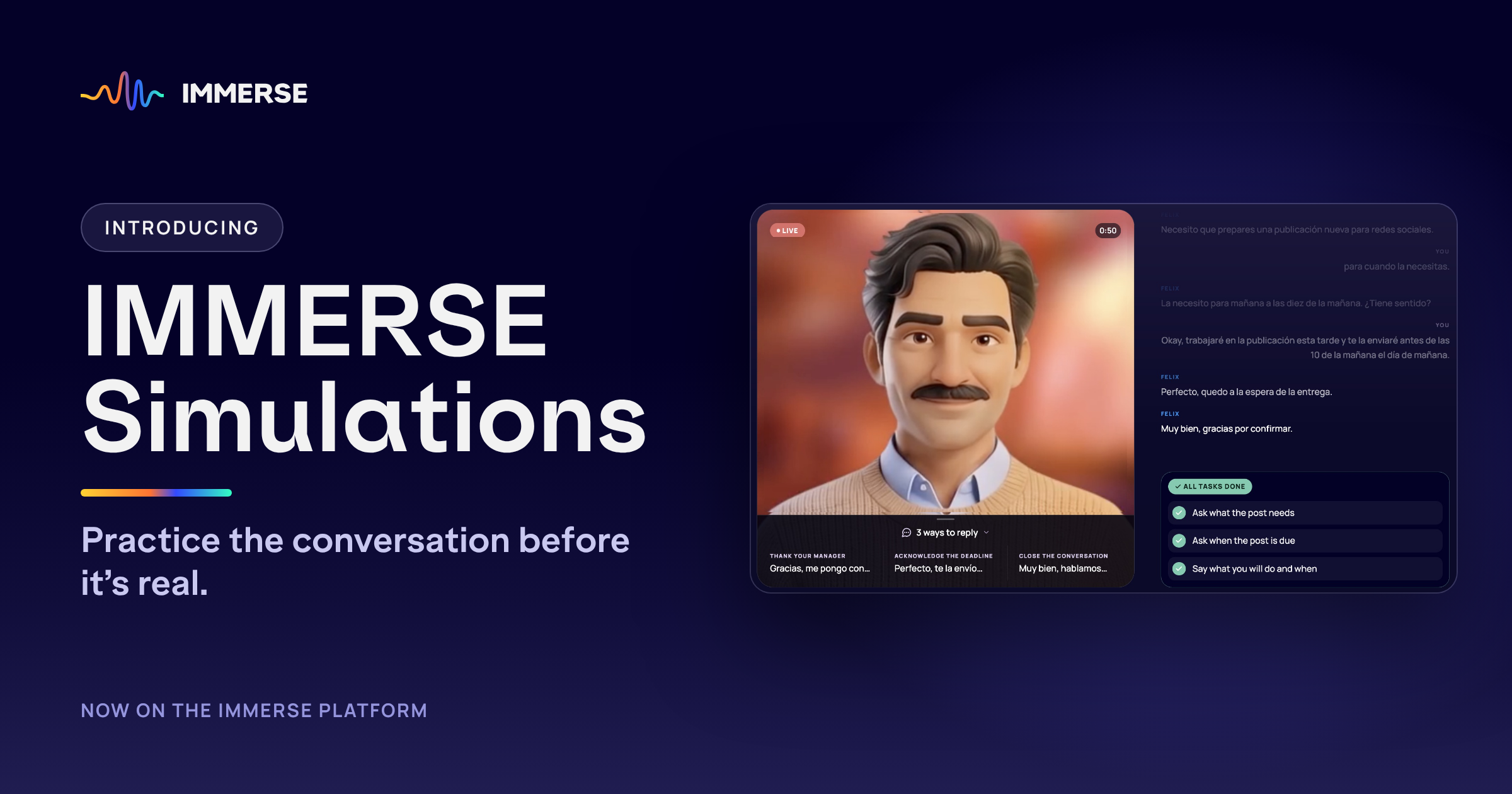
IMMERSE Simulations lets people rehearse the conversations their jobs demand with an AI coach that adapts to their role, their industry and every answer they give. Available today in every language IMMERSE teaches, at every level.
It's 5:40 p.m. in São Paulo. Camila, a team lead at a logistics company, has to tell a client in Mexico City that tomorrow's shipment will be two days late. She has studied Spanish for years. She passed her last level test. She knows the words for "delay," "partial shipment" and "new delivery date."
She opens a voice message, starts talking, stops, and deletes it. Then she tries again.
Most people who work in a second language know this moment. The knowledge is there. What's missing is the experience of having said it before, out loud, to someone who might push back.
A level isn't the same as being ready
Language programs are good at building knowledge: vocabulary, grammar, structure, a level on a certificate. But a level shows what someone knows, not whether they can handle the conversation their job puts in front of them tomorrow. Live work conversations move fast. A client pushes back, a manager asks a follow-up question, a meeting changes direction, and there's no time to look anything up.
Research on learning points in the same direction. A large meta-analysis of 145 studies found that simulation-based learning had a strong positive effect on building complex skills across fields (Chernikova et al., 2020). And research on second-language learners suggests that people who feel less anxious are more willing to speak up (Wang, Wang & Shi, 2022). Practice in realistic situations, in a setting where mistakes don't cost anything, is how people get there.
For HR and L&D leaders, this is the gap that's hardest to see: it rarely shows up in a training report, and more class hours don't close it. It's the difference between a language gap and a communication gap.
Introducing IMMERSE Simulations
Today we're launching IMMERSE Simulations: short, AI-powered roleplays of real workplace conversations.
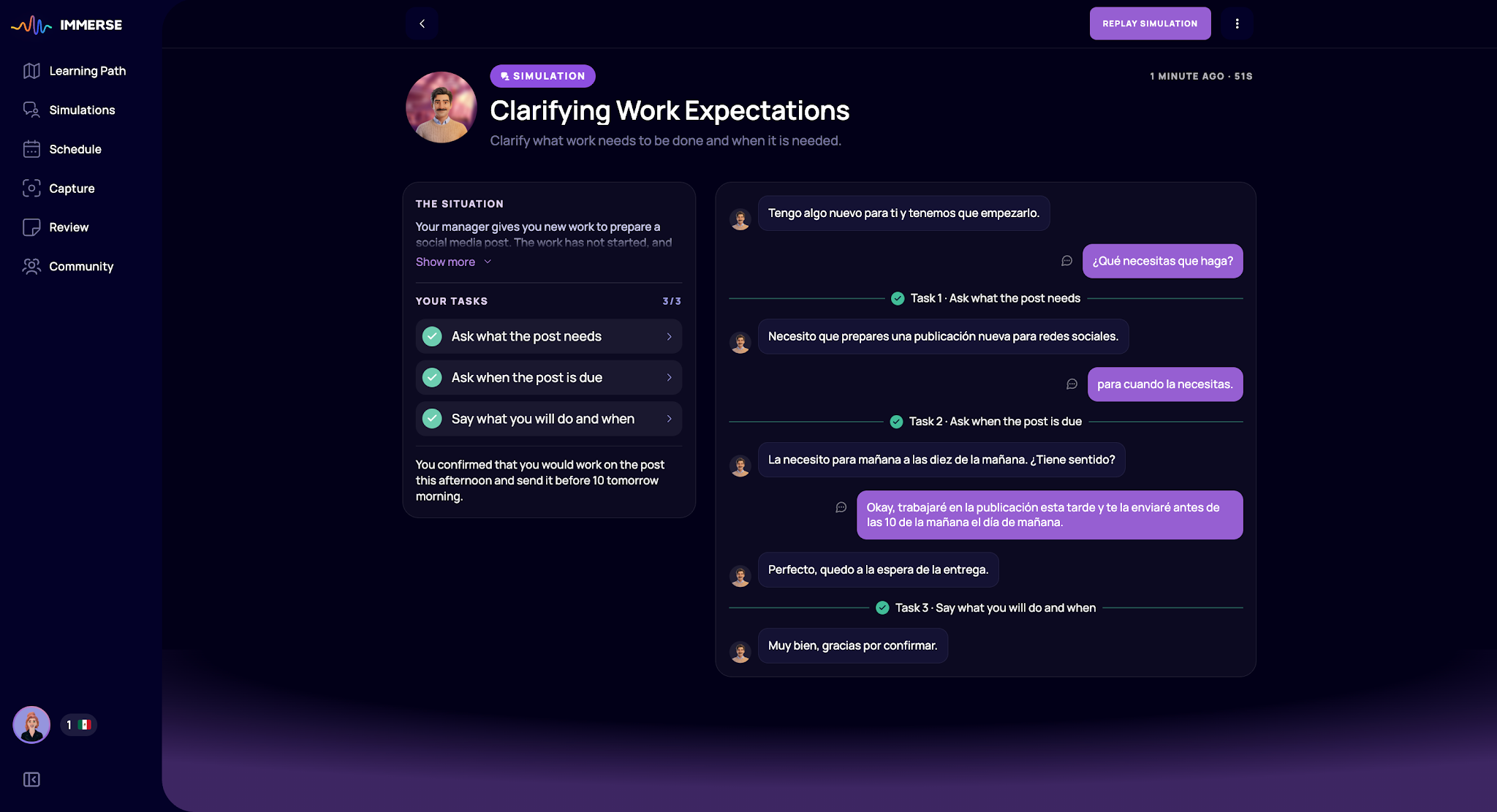
Learners talk out loud, in real time, with an AI coach: a client asking about a late delivery, a colleague clarifying a deadline, a guest with a complaint at the front desk. As the conversation unfolds, they work through clear communication tasks, like explaining the problem, proposing an alternative and agreeing on next steps. When they finish, they get feedback, and they can try again.
Simulations are available now on the IMMERSE platform, in every language IMMERSE teaches and at every level. They're part of how we think about fluency enablement: moving from learning a language to performing in it.
Built around each person's real work
A conversation only feels real if it sounds like your job. Before starting, learners add their context: their role, their industry and the areas they want to grow in. The situation stays the same, but the AI coach and the details adapt to their world.
Take one situation: explaining a problem to someone who isn't happy about it. For an account manager in manufacturing, it becomes a client waiting on a delayed order. For a front desk agent in a hotel, it becomes a guest who wants a different room. For a support analyst at a shared services center, it becomes an escalation call.
The AI coach doesn't follow a script. It responds to what the learner actually says, so they have to listen, adapt, and keep the conversation moving, just like on a real call. If someone gets stuck, they can ask for a hint instead of giving up.

A safe place to get it wrong first
Confidence at work rarely comes from knowing more words. It comes from having been there before.
That's why every simulation is built for repetition. Learners see which tasks they completed, read a short coach's note, and can review the full transcript of the conversation. Then they can run it again, try a different approach, and notice what works, as many times as they want. There's no audience and nothing at stake.
Back to Camila. The night before her call, she could practice explaining the delay three times: once to get the words out, once to handle the client's push for a new date, and once to sound like herself. By the time the real call starts, it's no longer the first time she's had it.
Practice the moment before it happens
Your teams already know a lot of the language. Simulations gives them a place to use it in the conversations their work depends on, before those conversations happen for real.
Want to see how your teams could practice the conversations they face every week? Talk to our team.
Frequently asked questions
What is IMMERSE Simulations?
IMMERSE Simulations are short, voice-based roleplays of real workplace conversations. Learners talk in real time with an AI coach, such as a client asking about a delayed delivery or a colleague clarifying a deadline. They complete communication tasks as the conversation unfolds, get feedback at the end and can try again. The goal is simple: practice the moment before it happens, so the real one feels familiar.
How is a simulation different from a language class?
A class builds knowledge of the language. A simulation puts that knowledge to work in a specific situation from the learner's job, with someone who reacts to what they say. There's no script to memorize. The AI coach responds to each answer, so learners have to listen, adapt, and keep the conversation moving, just as they would on a real call. Simulations work alongside classes, not instead of them.
How does a simulation adapt to each learner?
Learners add their role, their industry, and the areas they want to grow in. The AI coach and the details adapt to that context, so an account manager in manufacturing practices a different conversation from a team lead in IT services. During the conversation, the AI coach responds to what the learner actually says, so no two attempts play out exactly the same way.
Which languages and levels are available?
Simulations are available in every language IMMERSE teaches, including English, Spanish, French and Portuguese, and at every level. Beginners can practice simpler exchanges, while advanced learners take on more demanding conversations, like difficult client updates. That means one program can serve a whole multilingual workforce, not just one language or one group of employees.
Can learners repeat a simulation?
Yes, as many times as they like. Repetition is the point: each attempt is a low-stakes chance to find the right words, try a different approach and notice what works. Attempts are saved, so learners can look back and see how their answers have changed. By the time the real conversation arrives, they've already had it more than once.
How can my organization get access?
Simulations are available now on the IMMERSE platform and are included in current IMMERSE licenses, so existing customers can start today. If your organization isn't working with IMMERSE yet, talk to our team to see how Simulations could work for the conversations your teams handle every day.