
Misty Wilson

Jacob Furnari
Most corporate language programs treat AI as just another feature.
A chatbot here.
A simulated conversation there.
While these tools can feel innovative, they operate in isolation—disconnected from each other and from the real work your people do.
The result for you?
Practice that does not transfer. Learning that does not scale. And no reliable way to know if your investment is translating into workplace performance.
The problem isn't a lack of technology; it's a lack of a system.
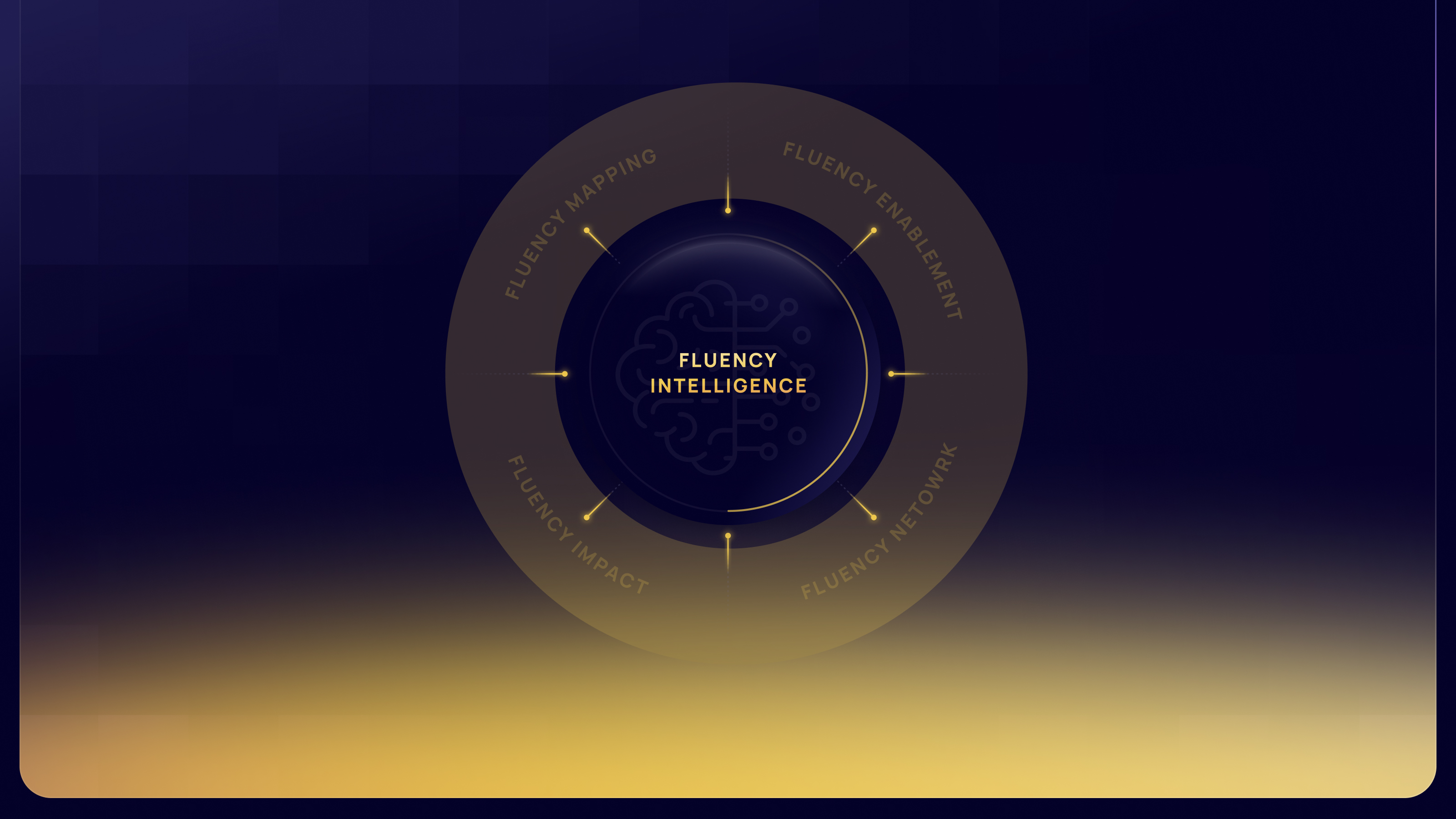
That’s why we built Fluency Intelligence: the adaptive, connective layer of the IMMERSE Fluency Performance Platform.
Think of it not as a single tool, but as the central nervous system for language development.
It’s the always-on layer of connectivity and intelligence that makes the entire platform responsive, adaptive, and coherent.
Fluency Intelligence is not a chatbot. It's the invisible architecture that ensures every interaction—with an instructor, an AI feature, or a peer—builds on the last towards a single goal: workplace performance.
How Fluency Intelligence works in practice
From Discrete Tools to a Cohesive System
The power of Fluency Intelligence comes from its closed-loop design. Every action generates a signal, and every signal informs the next interaction. This creates a continuous cycle of contextualized practice and validated progress.
1. Context-Driven Practice: Where Role Meets Reality
True fluency is role-specific. Fluency Intelligence embeds each learner's professional context—their role, industry, projects, and goals—directly into every practice scenario.
For example, a financial analyst in São Paulo doesn't get a generic "presentation" exercise. They practice explaining a quarterly variance report to global stakeholders, using the specific terminology and data narratives of their company.
Benefit for Learners: Practice feels immediately relevant, reducing cognitive load and accelerating skill transfer.
Benefit for Leaders: Training time is converted directly into job-ready capability, maximizing ROI from day one.
2. Learner-Directed Exploration: Autonomy Without the Guesswork
Fluency requires curiosity. Fluency Intelligence provides on-demand, contextual support within any activity—live or AI-powered. Learners can ask for clarifications, explore grammar nuances, or request examples mid-conversation.
The guidance is never generic; it's rooted in their immediate performance context and goals. This turns moments of confusion into powerful, self-directed learning opportunities.
The Outcome: Learners own their development path without derailing it. Momentum is maintained, and every exploration reinforces the core skills they need.
3. Performance Signals: Measuring Growth, Not Just Moments
One successful conversation isn't fluency. Fluency is a reliable pattern of effective communication.
Fluency Intelligence analyzes sustained communication behavior across time and scenarios, identifying patterns that show where a skill is emerging, stabilizing, or needs support. It measures what matters: mastery of high-value communication functions—such as presenting data, leading a discussion, or providing feedback—along with the fluency, accuracy, and strategic word choice that make those functions effective.
The Critical Shift: From measuring completion (“you completed the lesson”) to proving reliability (“you can run the meeting”).
The Business Translation: From Language Activity to Workplace Capability
Completion data is noise. Performance insight is power.
Fluency Intelligence does the critical translation work, turning language development data into a clear dashboard of functional workplace capabilities: meeting readiness, presentation fluency, negotiation agility, customer interaction confidence.
For the first time, L&D and business leaders can:
- Interpret progress in business terms.
- Align language development with strategic priorities (e.g., entering a new market, improving client satisfaction).
- Act with confidence, backed by evidence.
Language training stops being a subjective cost center and becomes a measurable driver of performance.
Why This Intelligence is Non-Negotiable for Fluency
Real fluency isn't built through exposure, but through a continuous cycle of immersive experience and evidence-based insight.
Expert live instruction provides the foundation. Adaptive AI offers boundless practice.
At IMMERSE, we built Fluency Intelligence to be the system that binds them into a coherent, responsive whole.
It ensures every piece of the journey is relevant, measured, and aligned with the ultimate goal: performance on the job.
Intelligence Creates the Evidence. Fluency Mapping Makes It Actionable.
This systemic intelligence generates a continuous stream of evidence from every practice and interaction.
Fluency Mapping is how we translate that evidence into a trusted source of truth.
It eliminates stressful, one-off assessments by embedding evaluation directly into the learning journey.
Every conversation and activity becomes a valid data point, culminating in a visual dashboard of readiness that both learners and leaders can understand and trust.
Ready to replace tests with trust?
Continue to Pillar 3: Fluency Mapping →
Review all five pillars of the Fluency Performance Platform →