.jpg)

University of Georgia: A Case Study
Using IMMERSE for Informal Language Learning
Eunkyoung Elaine Cha
Dr. Theodore J. Kopcha
Zheying Zhu
IMMERSE Insights
- Adult learners experienced a 13% overall reduction in foreign language anxiety after four weeks of informal IMMERSE use. For learners who participated in social meetups and conversational circles, this reduction reached 19%.
- Learners with higher initial anxiety were more likely to seek collaborative VR practice.
- Both independent AI practice and facilitated virtual interaction supported confidence and engagement.
Partner Background
A research team from the Department of Workforce Education and Instructional Technology at the University of Georgia was seeking a way to provide adult learners enrolled in the university’s ESL program with additional, informal speaking practice. They decided to partner with IMMERSE in order to provide learners with out-of-class, unlimited access to AI-VR learning and to study the effects this had on the informal learning experiences of adult learners and learners’ perceptions of using VR and AI for language learning.
The Challenge
The rapid integration of AI and VR into language education has expanded learning beyond formal classrooms into informal, self-directed learning. However, there remains a limited understanding of how language learners emotionally and cognitively engage with AI-embedded VR in such contexts. Therefore, researchers at the University of Georgia wanted to conduct a study investigating how adult language learners engage with AI-embedded VR outside of a formal classroom setting, with a particular focus on its effects on learners’ foreign language anxiety. The study also explored how learners perceive the implementation of VR in language learning. To improve confidence in the results, the study also accounted for the ways that factors such as learners’ cognitive load, sense of agency, and practice in the AI-embedded VR environment may have affected changes in their speaking anxiety.
The IMMERSE Solution
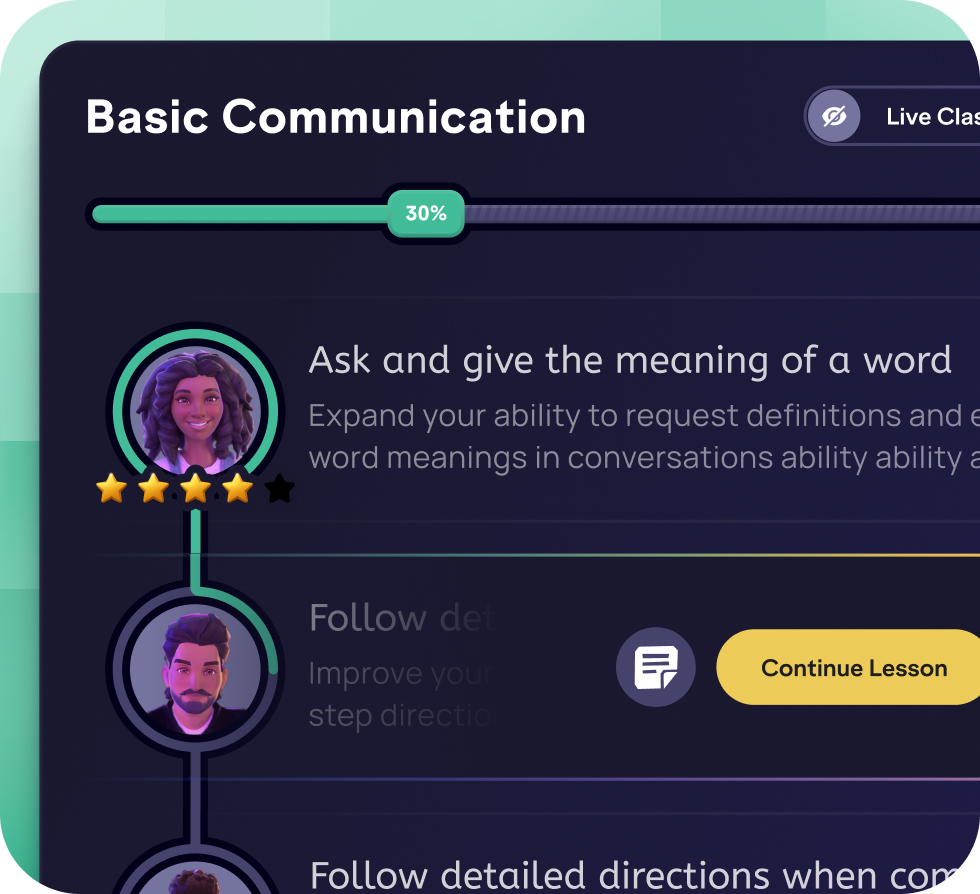
To support this initiative, the research team provided adult ESL learners with access to IMMERSE’s AI-embedded VR platform for informal, out-of-class practice. Learners could engage in AI-powered pronunciation, vocabulary, and conversation activities, participate in live lessons with human interlocutors, and explore public or private virtual environments designed to simulate real-world communication scenarios.
Study Design
Over a 4-week period, 21 adult learners enrolled in an ESL program used IMMERSE for English language learning outside of their formal classrooms. All learners had an intermediate to low-advanced English proficiency based on the English placement test administered by the program. At the end of each week, learners completed surveys, which asked about their perceived language anxiety and cognitive load, as well as the activities they engaged in when using IMMERSE (e.g., AI practice for vocabulary or pronunciation, live lessons with human interlocutors, public or private virtual spaces for exploration).
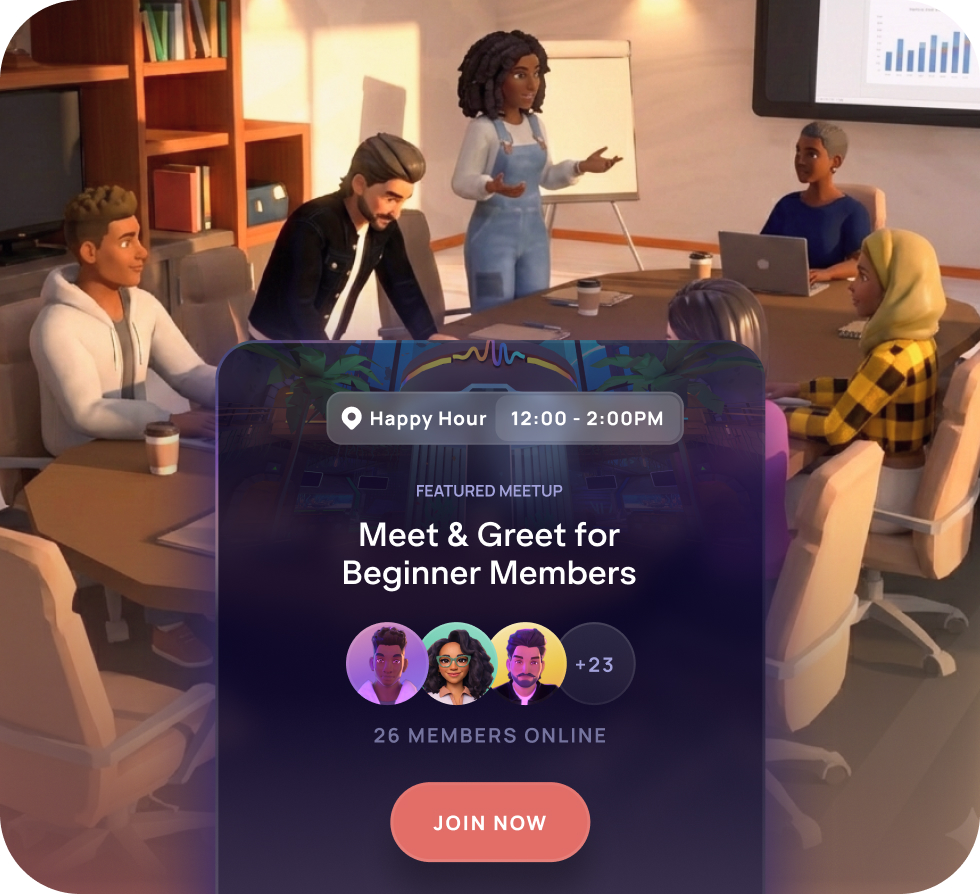
During the study, the research team facilitated optional conversational circles in collaboration with a teaching assistant of the ESL program. The conversational circles were held once a week for four weeks, where learners could meet in IMMERSE and explore the virtual world together, while having an informal conversation through which they could practice speaking English collaboratively. Among them, 8 learners participated in the optional conversational circles and 13 learners used IMMERSE independently. At the end of the study, a sub-group of learners and the teaching assistant were interviewed to share their perceptions and experiences using IMMERSE for their informal language teaching and learning.
Results and Impact
Impact of IMMERSE on Foreign Language Anxiety
The findings showed an overall reduction in anxiety and cognitive load over time, with a larger decrease observed among learners who participated in the informal conversational circles.
Reduced Anxiety and Cognitive Load
Overall, anxiety decreased by 13% and cognitive load by 10%. Learners who used IMMERSE independently outside formal classroom settings reported a 9% reduction in perceived foreign language anxiety and an 11% reduction in cognitive load. In contrast, learners who engaged in the conversational circles in IMMERSE reported a larger decrease in foreign language anxiety (19%) and a slightly smaller decrease in cognitive load (9%).
Activities Engaged with in IMMERSE
Learners who preferred to participate in informal conversational circles in IMMERSE reported primarily engaging in AI-based pronunciation (86%) and vocabulary (71%) practice activities, whereas learners who chose to use IMMERSE independently reported primarily engaging in AI conversation activities (78%).
Further results suggested that learners with higher foreign language anxiety had a higher tendency to participate in conversational circles where they could seek for necessary scaffolding in language learning.
Learner and Teacher Perspectives
- Teacher’s Perspectives
- “VR helped students who were shy or insecure engage in funny things in the virtual world. It made students feel more comfortable.”
- “VR is a great resource that has immersive and situational benefits. I hope it is more accessible across institutions.”
- “Students were very motivated…VR has potential in alleviating worries. You can practice before encountering the real world, feeling more prepared.”
- “VR creates a safe place to build connections.”
- Learners’ Perspectives
- “It has less location barriers, it is convenient, and I can see more clearly about the content. It enhances accessibility to the learning contents.”
- “I have anxiety when speaking English. I don’t want to make people wait, make silence or blank moments, get embarrassed, or make people bored. And I think VR is better because it is not face-to-face. People are not focusing on me the whole time. People engage with other things. In the real world, they look me in the eyes. In VR, facial expressions are hidden.”
- “VR makes the learning experience more playful and enjoyable. The environment in IMMERSE, which had buttons and objects, was engaging, cute, and interesting.”
- “It made learning like a game. Sitting in a classroom in a traditional way can be boring. Virtual worlds offer a playful way of learning languages. It is engaging and immersive.”
- “AI chatbots in IMMERSE are a great asset for those who have less opportunities to talk with native people.”
Key Takeaways
IMMERSE offers immersive and authentic environments, where learners can engage in language learning in a more fun and enjoyable way. The results suggest that the learning environment can provide an emotionally safe space for learners to practice the target language in a way that may reduce anxiety.
The study also underscores the value of flexibility. Independent AI-driven practice supports self-directed learners, while lightly facilitated conversational circles may offer additional scaffolding for those experiencing higher levels of anxiety.
To learn more about how IMMERSE supports universities in extending speaking practice beyond the classroom, visit our research page.

Tricia Thrasher, PhD